
Yinnar, Yinnar South Landcare Group - August 2026
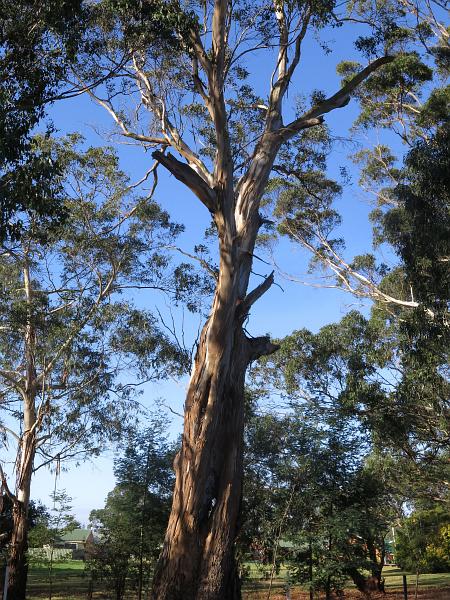
This old Strzelecki gum has many hollows and pipes
By J Duncan
One of our group’s main priorities is to encourage and assist where we can in preserving remnant vegetation. Some of the most concern in relation to remnant vegetation is the loss of isolated old trees in paddocks.
Old trees, paddock trees and the life they support are all threatened by stock camping too close to them, land clearing, deliberate setting of fires under them, changed drainage patterns and a changing and heating climate. It takes about 80 to 150 years for tree hollows to form, so every time a hollow-bearing tree is lost, a whole lot of other species come under increasing stress.
The creatures that rely on tree hollows are often very useful in providing pest control and as part of the natural world. Many insect, bird, mammal amphibian and reptile species are now diminishing in number and some are heading for extinction if conditions for their survival keep on deteriorating. Preserving and protecting paddock trees, and linking them to other areas of native vegetation is useful for the animals that use the trees and beneficial to the farms that host them. For example, tiny bats and birds spend all night and all day eating insects, and many hawks and owls hunt rabbits and other rodents.
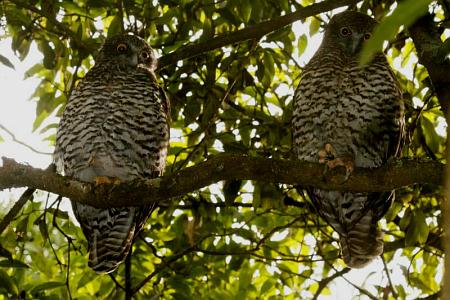
Powerful Owls need large tree hollows to breed and
understorey to roost in during the day.
Hollows come in many shapes and sizes as do the species that use them.
Owls and greater gliders use large ones, as do colonies of some species of microbat. Other microbats might roost in a crack in the bark of a large tree. Some roost hollows are not even trees. Eastern rosellas and blue–winged parrots often nest in old hollow fence posts and many people are familiar with the sort of alternative roost sites that some species of microbats have adapted to.
These tiny creatures are sometimes found living in roofs, sheds and other inventive places such as inside old coats etc. If they are found there, they are likely to be one of the long-eared bats. (Nyctophilus gouldii or Nyctophilus geffroyii)
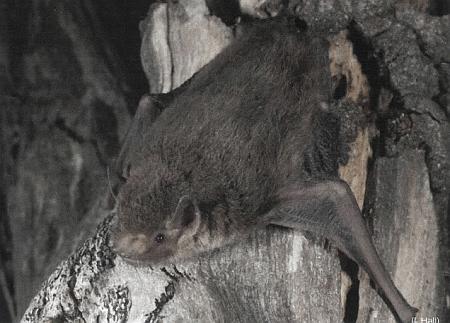
Little Forest Bats are 3-5cm long and need room for
between one and 150 individuals to roost
As we are now having the sort of temperatures that will cause microbats to hibernate or go into a lighter sleep state called torpor, it is important not to disturb them at this time of year. They have spent the autumn building up just enough fat to use as a food reserve to get them through the season. Heating themselves up enough to be able to fly, and then chasing less abundant insects to eat and replenish their energy is often too difficult and they will die.
Blue-winged parrots are a very special little bird that can often be seen here in summer. The natural tree hollows that they use are small and often located in stags and smaller dead trees that may be leaning against larger ones. These particular hollows are said to develop earlier in messmate stringybarks than in other trees the same age. So it is good to leave these ratty looking dead trees in place.
Greater gliders use tree hollows to nest and for daytime roosts as well as for temporary refuges while foraging. They can only glide a maximum of 150m so retaining paddock trees that are close enough to trees that the gliders can launch from is helpful. Like koalas, the gliders’ only food is eucalyptus leaves. For both species, more gum trees for foraging are needed. Koalas like trees to be close enough for them to jump between trees and gliders also need hollow-bearing trees for roosting and hanging out. Each glider might use multiple tree hollows while foraging at night, so retaining groups of trees is important.
The best chance to keep paddock trees alive and well is to exclude farm animals and then plant smaller trees, shrubs, native grasses and groundcovers around them. To restore the soil, it is best to leave leaf litter and coarse woody debris in place so that it can rot down, feed the soil and provide habitat for the fungi and invertebrates that digest it. Birds will then come and eat the invertebrates and all this action will return fertility to the soil in a form that the trees can digest. Over the years micro-organisms will build up their numbers enough to eat the leaf litter at the same rate that it accumulates, while birds scratching in it for food will turn over the soil and accelerate decomposition.
Healthy soil retains more moisture and has better nutrient cycles. Stock camping under paddock trees will kill them. Compacted soil is not healthy soil. Rubbed-off or eaten bark on living trees cannot protect or nourish the tree canopy. The trees take up their nutrients from soil bacteria and fungi that are not adapted to large concentrations of the nutrients found in farm animals’ urine and manure. The trees can benefit the farm animals by providing shelter, shade and soil fertility, but excluding stock at least as far as the trees’ drip line is needed for these important and often ancient trees to survive.
Our group can apply for funding for on-ground works such as fencing, advise on suitable species for understorey planting, and/ or organise volunteers for planting days. We also grow small numbers of locally indigenous plants to supply our own sites and other local revegetation initiatives.