

Yinnar, Yinnar South Landcare - Microbats
By J. Duncan.
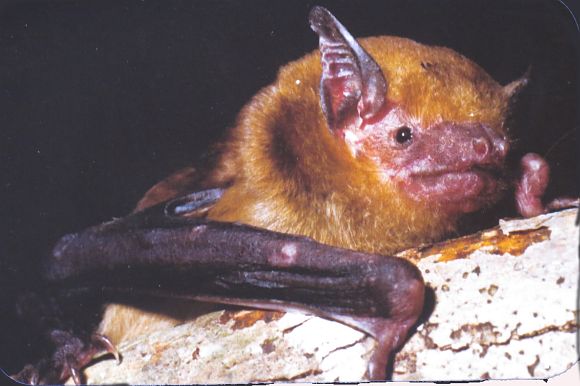
The six and a half cm long Eastern Falsistrelle is large for a microbat
Tree hollows come in many shapes and sizes and many different species of fauna use therm.
According to NSW research, hollow-dependent species include at least 46 mammals, 81 birds, 31 reptiles and 16 frogs. Of these, 40 species are listed as threatened with extinction. This is why the ‘loss of hollow-bearing trees’ has been listed as a Key Threatening Process.
This year, Yinnar, Yinnar South Landcare group is looking closely at one of the denizens of the trees, and a tiny one at that, Microbats.
Being nocturnal, microbats have fewer predators than small birds and so are far more likely to be found in and around paddock trees. Their echolocation calls allow them to find and eat insects at night. What is not to like about an animal like the Little Forest Bat that eats its own weight in mosquitoes every night?
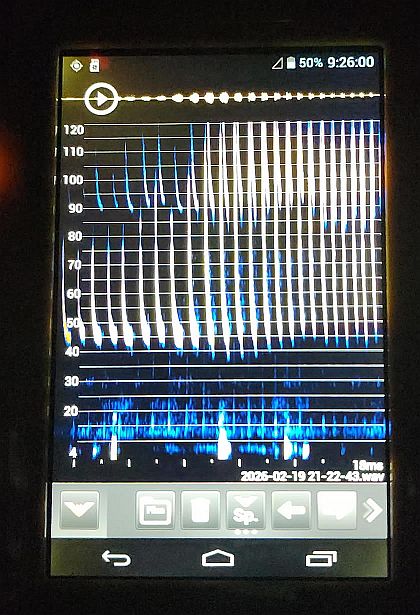
Bat calls will show up on our detectors as sonograms
There is an opportunity to find out more about bats coming up on March 25, when our Landcare Group will repeat the very successful community workshop we held last year in Yinnar.
This twilight event is on Wednesday March 25 from 7.00 p.m. The indoor workshop will be followed by a bat detection walk. Everything will conclude by about 8.30 p.m. and if you miss one of the limited places in the walk, you will be finished at about sunset.
More information about this when you book. Booking is essential and the cost is $5 for adults with those under 18 attending free.
Bookings opened on Sunday March 1. You can use this link to book at TryBooking https://www.trybooking.com/DJVUK
Our group has also bought two ultrasonic bat detectors. Our members and volunteers are busy learning to use the equipment and the software used to analyse the calls that we find. We need this equipment because most bat calls are not in the range of human hearing. By the time of the March 25 workshop we should have a few dates ready for those who would like to join us on more bat walks.
Old trees with hollows are a fast disappearing feature of our local landscapes, and many venerable remnant trees in paddocks are showing unmistakable signs of stress. Looking after these trees benefits wildlife. Wildlife includes species large and small. Microbats, birds, pollinating insects and tiny invertebrates eating up dead plant and animal matter are some of the smaller ones with big benefits that are often overlooked.
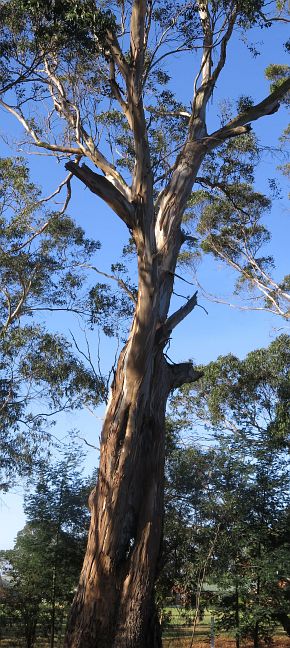
this old Strzelecki gum has many hollows
and pipes
A biodiverse landscape, supports pest control, seed dispersal, and ecological resilience. More trees cool the atmosphere and provide shade. There are some species of native trees and shrubs that can withstand higher nutrient loads and provide denser shade than tall eucalypts. Blackwoods, black sheoaks and drooping sheoaks are easily grown local trees in this group. By fencing off old trees and planting understorey such as native grasses and shrubs around them, you can help the trees and the farm animals at the same time.
There is more about farm trees and tree hollows in a short (5 minute) video ‘Living in the gaps’ – the vital role of tree hollows from the Nature Conservation Council and Mid Lachlan Landcare, showing how farmers are seeing real benefits from conserving hollow trees on their properties.
https://fireandrestoration.org.au/living-in-the-gaps-the-vital-role-of-tree-hollows/
Another video, ‘Home is Where the Hollow Is’ from the NSW Environment Department shows more about how the hollows are important for a range of creatures
https://www.environment.nsw.gov.au/topics/animals-and-plants/threatened-species/saving-our-species-program/resources/home-where-hollow
If you’re a landholder around Yinnar and you would like to protect your paddock trees, our group may be able to apply for a grant to pay for fencing materials, weed control and trees to plant. These grants do not cover installing the fence or planting the trees. You would need to be able to cost, map and carry out your project. Our small volunteer group has some, but limited, capacity to assist you. Victorian Landcare Grants are awarded to groups rather than individuals. Applications will be due in April/ May, so the time to plan is now.
You can contact Yinnar Landcare at yinnar.landcare@gmail.com
https://www.landcarevic.org.au/groups/westgippsland/yinnar-south/