
Plants in my Garden - Hakea clavata
By Mike Beamish
Species: Hakea clavata
Family: Proteaceae
Derivation:
Hakea: Named after Baron Christian Ludwig von Hake (pronounced ‘hark’), 1745-1818, a German patron of botany.
Clavata: From Latin clava, meaning ‘a club’. Used botanically to indicate club-shaped, in this case referring to the leaves.
Common Name: Coastal or Cactus Hakea.
Distribution:
Western Australia, one record from the eastern Fitzgerald River NP, but most of the population is eastwards from Esperance to Israelite Bay, growing on granite outcrops close to the coast.
Description:
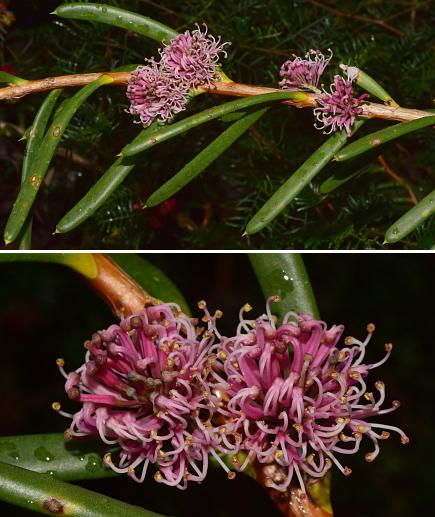
A small or dwarf, scrambling shrub, usually no more than 1m tall, probably influenced by its preferred habitat, growing in cracks and pockets on exposed granite outcrops. The leaves are flattened, narrowly club-shaped, fleshy and thick, with a sharp-pointed tip (mucro). They are mid-green, glabrous (no hairs), nearly elliptic in cross-section and up to 8cm long and 1cm wide. Flowers appear in terminal and axillary clusters, are deep pinkish-red to pale pink or white in colour and can occur anytime from January to October, but usually with a flush in August and September. Fruits are relatively smooth and narrowly ovoid with 2 small dorsal horns and are up to 2cm long. Seeds are not retained on the plant, as the capsules open when seeds are mature.
Opinion:
I have two of these: one is in the ground in the bed adjacent to the western side driveway, is 1m tall but very narrow and is the plant shown in the photos; the other is in a bottomless concrete tub/pipe adjacent to the northern driveway, is marginally bushier but much shorter at about 50cm tall. This one will have the better drainage, being elevated 40cm or so above ground level, but it also has more competition as there are two other plants in the tub with it, a Golden Grevillea (G. chrysophaea) and a Frog Hakea (H. nitida), both of which are bigger. Also, the tub is nestled in a quite crowded part of the garden, so shade could be holding it back too. Neither of my plants are anywhere near a granite outcrop, so hopefully that is not a critical factor in maintaining this species in cultivation.
Both my plants came from the APS LV raffle table, so presumably are cutting grown. Though they have both flowered sparsely, neither appear to have been pollinated as no seed capsules have formed. Seed would probably be easier to use for propagation, but unlike our local Hakeas, this species does not retain seed once it is mature, so obtaining ripe seed in this part of the world could be problematic.
The Australian Plants Society Latrobe Valley Group hosts monthly activities, excursions and /or meetings. Interested persons are welcome to join in, please contact Mike for more information, email mcandcjb@gmail.com or phone 0447 452 755.
Sources: WA Plant Names and their Meanings – Sharr.
Hakeas: A Field and Garden Guide – Holliday.
Banksias, Waratahs & Grevilleas, etc – Wrigley & Fagg.