
Looking Back - History nurtures memories
By Leo Billington
Historical memories can be cathartic. History need not be dismal. Let us take a look with reminders of Morwell’s history. How are your memories?
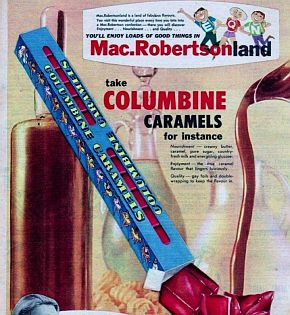
Columbines, those cute, tasty small cubes of caramel. When you have finished one you often said ‘that's moreish’; that is you could eat some more. Initially made by the Pascall Confectionery company it was during the late 1940s, when manufactured and marketed by MacRobertson’s confectionery, that these beautifully sweet, sticky, tooth-defying caramel lollies in shiny, distinctive blue and pink wrappers came in a long thin box. Just the thing to encourage a new girlfriend.
Many will recall a Mayflower. It could describe someone who has given you momentary bliss and you are thankful for that, even though you are not destined to end up together. It was a 17th-century English merchant ship that transported 102 English Pilgrims and approximately 30 crew from Plymouth, England, to the New World in 1620.
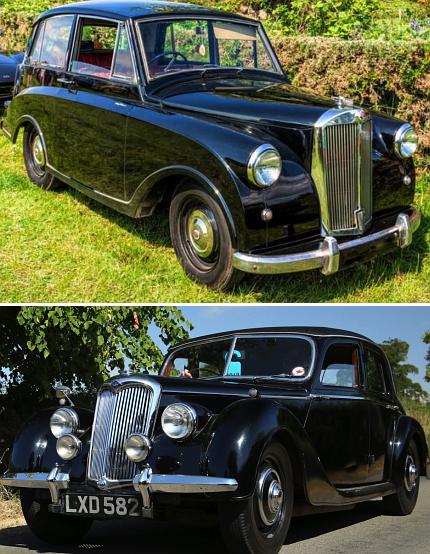
It was a name given to a new family car manufactured by the Standard Motor Company (Australia) Ltd. Marketed as a saloon for a niche Australian market, the Morwell dealer was Milner and Lawrence Vanguard Motors, located at the corner of Fleming and Church Streets. Their promotion of a Mayflower, using the Morwell Advertiser, commenced in about February 1951.
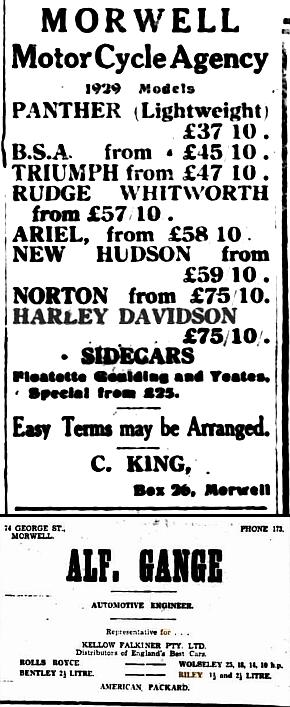
There are Harley-Davidson motor bike enthusiasts out there. They are so focussed that a hyphen must be in the name. If not, a failure to do so will create serious problems!
Yes, these motor bikes were available for sale in Morwell. Mr C King was advertising his range of motor cycles during the 1930’s. Harleys seemed to be highly priced back then. Sometimes smaller private advertisements offered this “darling of motor bikes” as ex-Army, mainly in the late 1940’s. An intriguing business located in Commercial Road, (approximately opposite today’s public transport bus exchange), was called the ‘Morwell Motor-Cycle Exchange.’ Their advertisement (Morwell Advertiser May 29, 1931) while difficult to read, is also somewhat vague about what can be exchanged; although there is reference to repairs.
While promotional efforts tried to sell Mayflowers, generally it was not one of the most popular cars introduced to Australia. There is literature around telling customers back then, that if a letter was sent to the Standard Motor Company, a car would be sent to your home for an on-site demonstration. Hence, along came the Riley to force its way into Australia.
Named after its creator, William Riley Junior, the company started as part of the Nuffield Company in 1890. Over past decades, and through various company mergers, in July 1969 British Leyland announced the immediate end of Riley production. Today, the Riley trademark is owned by BMW.
Before Australian cars were built on steel frames, Rileys were built on timber frames, nonetheless sold as a commodious car - roomy and comfortable, and seen as a prestige vehicle as well.
In Morwell, Alf Gange was a local representative for Riley cars along with its stablemate, the Wolseley. During the early 1950’s, Traralgon Auto Sales were regular advertisers in the Morwell Advertiser and occasionally, had a Riley for sale - generally where a deposit was first required.
Locally, there are keen Riley devotees working all hours, all weeks and years to reconstruct their sleek, commodious Riley. One day, gleaming new generation Rileys will appear once again.
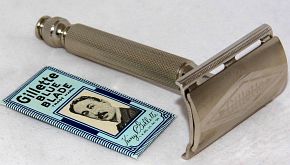
Gillette. Surely this name brings back memories - being clean shaven made men seem more trustworthy (at least that is what society thought). What a way to quick promotion in earlier times; even a quick way to a woman’s heart. Even the W. A. Purvis advertisement in November 1946 told us a Gillett razor was a “suitable gift line for men”.
King Camp Gillett was born in January 1855; and died in July 1932. The Gillette Safety Razor Company’s first sale, in 1903, consisted of a lot of 51 razors and 168 blades; by the end of 1904, it had produced 90,000 razors and 12,400,000 blades. Gillette’s innovative sales strategy—he sold the razors for a loss and made his profits on the blades—helped make the product a success. A simple, logical wise strategy towards greater sales. That is, ‘sell the sizzle not the sausage'; do not buy a product, buy the benefits of that product.
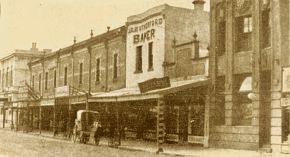
Rutherford’s Bakery was for many years, centre stage in Commercial Road, Morwell. Fresh bread, pies, pasties, cakes and everything in-between. Home deliveries were commonplace after the second World War.
After retiring from management of the Pottery Works, Mr Samuel Cooper took an active part in a local bakery business conducted by members of his family, until it was eventually sold and then owned by Mr Jim Rutherford.
As manager of the Pottery Works, Samuel Cooper had experience supervising the making of tea-pots, jugs, basins, drain pipes and bricks, which were supplied locally, as well as elsewhere. It was in April 1914 that the Victorian Brick Commission visited Morwell. Three bureaucrats were appointed to obtain evidence concerning the manufacture, and distribution, and prices generally ruling in the expanding Victorian brick industry.
It was at this inquisition, without any local Morwell Shire Councillors in attendance, that Samuel certainly made sure Morwell’s brick business enabled users to obtain bricks at a fair price.
Samuel and his wife Eliza, are interred in the Hazelwood Cemetery.
The largest brick manufacturer which started in 1870 was the Hoffman Brick and Tile Company based in Melbourne. Thorough research reveals this company was a keen supporter of the Victorian Brick Commission.
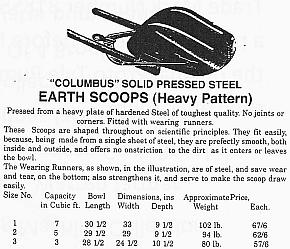
One memory “for the road.” Some readers may remember earth scoops used to dig and clean dams and trenches to drain swampy areas.