

Looking Back - July 2026 - Morwell's Heydays
By Leo Billington
A montage from Morwell’s heydays
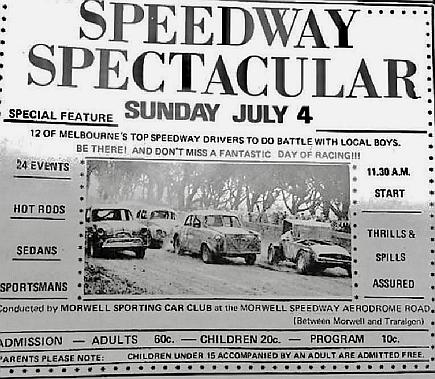
Many readers will recall those magic days when hot rods and modified sedans would be transported to the Morwell Speedway, Aerodrome Road Morwell (or was it West Traralgon?). Nonetheless, at 60 cents for admission, cheaper for children, who could resist?
Kids would ride pushbikes from Morwell and Traralgon; or cadge a ride; or walk; or whatever was feasible and popular just to see noise. Mud, dust, petrol, oil, swearing, what a cacophony to brag about next day.
Adjacent to the aerodrome was an approximate ¼ mile oval (not what a computer these days would
sketch) gravel covered track. Although the area was basically swamp, ash and clinker refuse from
 Morwell’s briquette and power station, (courtesy of the SECV) hardened the soft ground. A few
potentially hazardous trees were easily removed. In the day, red tape was more flexible. Anyway,
these nuisance trees interrupted spectators who paid good money to have a grandstand view close to
the real action.
Morwell’s briquette and power station, (courtesy of the SECV) hardened the soft ground. A few
potentially hazardous trees were easily removed. In the day, red tape was more flexible. Anyway,
these nuisance trees interrupted spectators who paid good money to have a grandstand view close to
the real action.
Sunday July 2, 1966 saw a large advertisement in the Latrobe Valley Express (first issue was published on June 18, 1965) announcing a “Speedway Spectacular”. Parents were responsible for their children’s behaviour.
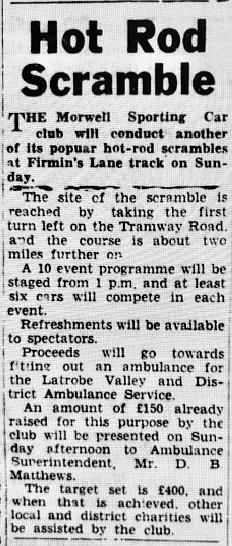
The Morwell Sporting Car Club at an earlier time held hot-rod scrambles on the southern side of Firmin’s Lane. Entry was via Tramway Road, left turn into Firmin’s Lane and then right turn into a paddock. Easy to access, ideal site, away from suburbia, perhaps annoying a few cows and lots of rabbits. The accompanying advertisement was in the Morwell Advertiser, Thursday July 2, 1959.
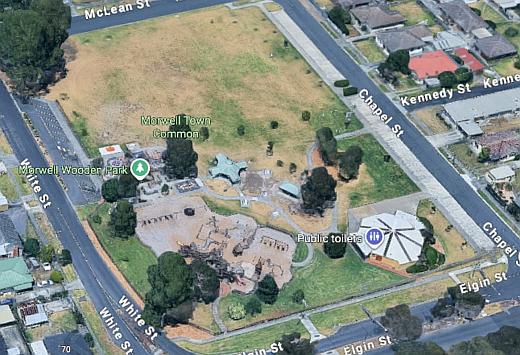
Morwell has a Town Common; or as many older residents will opine, Morwell once had a Town Common. It is located on the lands of the Braiakaulung people.
A google definition in such an area is “usually an area of grassy ground in the middle of the town or village that was traditionally used for common folk to graze their animals.” Not sure who are “common folk” but England’s history might explain, and Morwell as a then hamlet attracted folk from Britain. So it was only natural for land to be set aside.
Our Town Common may have been seen as waste land, wasted land albeit it allowed junior football games, cricket competitions, a circus or two, exercise for walkers. It was generally viewed as a folly.
Councillor Edgar Walkley was the Morwell Shire Council President for one year, 1927 to 1928. From his Gunyah farm, where his prized 60 dairy cows battled ragwort and blackberries, Councillor Walkley’s nomination for high office nearly did not happen, old records show he was unsure about becoming President. He was more concerned about having a suitable road to his farm.
At a September 1928 council meeting, Councillors were faced with deliberations about allowing camping on Morwell’s Town Common. Councillor Walkley was not keen. He asked that this matter be “handballed” to Morwell’s Recreation Ground Committee.
Councillor Walkley thought campers could set-up on the banks of Morwell River, perhaps out on the Thorpdale Road. However he also was entirely enthusiastic about a site for croquet, and suggested development of an area east of town, close to the former band hall opposite the Morwell State School.
A meeting of those interested in reorganising the Morwell Cricket Club was called at the Morwell Advertiser office on Monday evening August 25, 1901 at 8.00 pm.
Cricket practice was scheduled on the Town Common, for Saturday afternoon, August 31. Intending players were invited to attend. (Morwell Advertiser, Friday August 30, 1901.)
Being close to the Church of England in Chapel Street, the Sunday School had some of their annual picnics during an afternoon with games on the Town Common and in the evening a series of lantern views was shown in the Mechanics Hall. As always, tea and supper were provided. (Morwell Advertiser, Friday July 13, 1900.)
The Councillors continued onwards to debate an effective use of Morwell’s Town Common. Councillor Jim Bush was not sure, during a Council meeting in May 1953, about a request from the Morwell Hockey Club to use the Town Common; he remained quiet.
At the same Council meeting, Councillor Reg Davey offered a portion of his Latrobe Road paddock to the hockey club.
Back in early October 1935, Councillor Alf Ronald (17 years on Council) was concerned about danger and nuisance of cattle and horses “roaming the town day and night. The Council had made a law prohibiting it in the town area and they should take whatever action was necessary to see that it was carried out.” He suggested a retention yard be erected in a corner of the Town Common. (Morwell Advertiser, Thursday October 3, 1935)
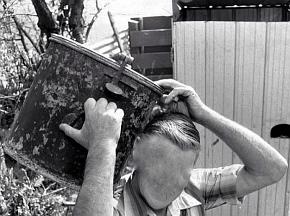
A bye-law within the Shire of Morwell was passed on November 1, 1900 to regulate “the removal and disposal of night soil.” Yes, the matter was becoming a real concern; but out in the farming areas, it was realised the amount of fertilizing material that was contained in night soil. In town, it was an entirely different matter. Readers may remember the “poo man”.
Unfortunately, there were accusations that night soil was being buried in the Roger and Madden Streets area (Morwell Advertiser September 29, 1949). The possibilities of a sewerage scheme were first investigated by the Shire Engineer (Mr F.A. Horsfall) in about 1940, who made preliminary estimates and prepared contour plans. There the matter rested for several years until an accurate costing was agreed. This saga continues in the next edition.